
Archaeology
I'm a paragraph. Click here to add your own text and edit me. It’s easy. Just click “Edit Text” or double click me to add your own content and make changes to the font. I’m a great place for you to tell a story and let your users know a little more about you.1




Pidurangala
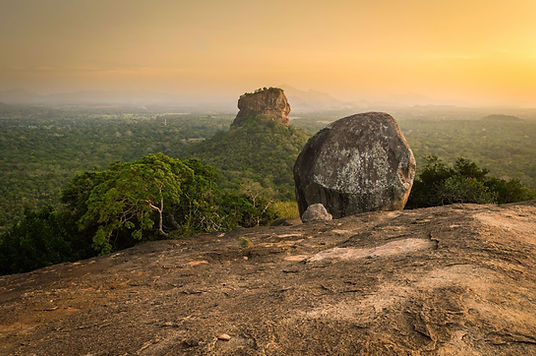
Perhaps the lesser known sister of the two giant rocks which dominate the Sigiriya landscape is Pidurangala, however it’s certainly not lacking in visitors. Possibly even more than ever now with the advent of Instagram - the most ‘Instagrammed’ photo in Sri Lanka being of Sigiriya as seen from the summit of Pidurangala.
Akin to a giant tree stump, this massive granite rock with an almost oval summit is challenging to climb in certain places, however once you arrive at the summit the views of the surrounding forests, paddy fields dotted with lakes and of course the Sigirya rock fortress itself as seen flanked on each side by a carpet of emerald tropical jungle, are simply glorious.
Pidurangala was used as a Buddhist monastery from as far back as the 1stand 2ndcentury B.C and became a prominent place during the reign of King Kassapa of Sigiriya. The temple is one of the few 'panchavasa', consisting of five main ritual buildings: Chapter House, Image House, Bodhighara, Preaching hall, Sangharama (Bikku Residence Building). In addition to these once can witness the inscriptions with drip ledged caves as well as the statue of the reclining Buddha found in one of the open caves is considered to be the largest Buddha image in Asia constructed of clay and brick.
Enjoy the challenging climb and be prepared to squeeze through some tight places to get to the top!
To read more on Pidurangala and its lesser known history, you can read Chapter 07 pp 308 - 318 in the Sigiriya & Beyond book


RITIGALA
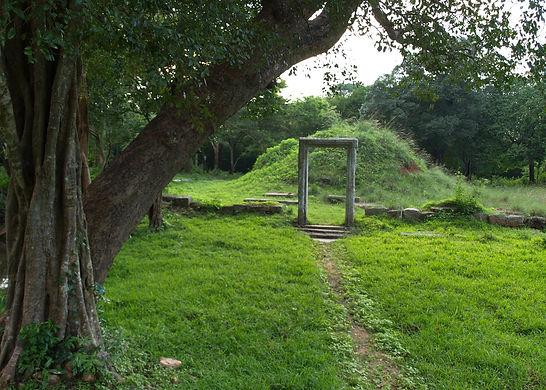
Possibly one of the most enchanting places to visit and one of the best restored archaeological forest monastery sites in Sri Lanka, Ritigala had been occupied as a forest monastery from as far back as 1stcentury B.C. Make sure you read up the literature and find out more about the various architectural aspects of the site as you will appreciate the visit so much more that way.
The well thought out designs, ingenious monolithic constructions, vestiges of elegant landscaping are all enough to leave you a gasp at the engineering sophistication of the ancient Sinhalese from thousands of years ago.
Now covered over in giant buttress rooted trees and dark creeping vines which hang from the forest canopy, Ritigala is more than an archaeological site. It is a lovely place to enjoy the beauty of Sri Lanka’s tropical forests, to breath in the fresh air and take a stroll along the paved walkways which had been created for the many hundreds of arahats who are said to have lived here almost 1,600 years ago.
A great place for lovers of slow travel as well as nature and archaeology lovers, Ritigala will keep you wanting to come back for more.
To read more on Ritigala and its many archeological and architectural marvels, you can read Chapter 06 pp 228 - 239 in the Sigiriya & Beyond book
Kaludiya Pokuna
It seems the ancient Sri Lankans were the masters of sophisticated sustainable design. Kaludiya Pokuna archeological site is yet another example of their creative ingenuity where the elements of nature were carefully used to enhance the designs of what was once yet another major forest monastery in Sri Lanka dating back to the 1stcentury B.C.
A jumble of giant rock boulders, fantastically large buttress trees, giant creepers hanging off the forest ceiling all add drama to this site which has a marked spiritual energy as you enter it. Sit quietly in the ancient drip ledge caves or amongst the gigantic tree roots, close your eyes and spend a moment in quiet reflective meditation to really absorb the fantastic energy of the place.
Kaludiya pokuna is a wonderful place for travellers who like exploring wild places and appreciate the wilderness as well as archaeology. It is not a very well-known tourist destination, thanks to which it has been pretty well preserved over the years from trodding feet and plastic waste.
To read more on Kaludiyapokuna site and its history and attractions, you can read Chapter 04 pp 154 - 160 in the Sigiriya & Beyond book


Dambulla Cave Temple
One of the most visited sites in Sri Lanka by both locals and tourists is the Dambulla Caves, designated a UNESCO World Heritage site in the 1990’s and listed as one of the top ten sacred caved in the world by National Geographic.
With a history dating back to 2ndcentury B.C. the Dambulla Rock Cave complex includes 5 main caves which are open to visitors, housing breathtaking cave paintings. The largest cave Maharaja Lena is one of the largest Buddhist cave shrines in the world. In addition to the intricate paintings visitor can also find the statues of 157 Buddhas, 5 gods as well as 3 kings here.
The spiritual energy within the caves is tangible and especially the Maharaja Lena is a wonderful place to sit in quiet meditation. The history of the caves begs to be learned as it has been a Buddhist temple continuously for over 23 centuries – pretty impressive! It has also been a place of hiding for Kings fleeing invaders and a refuge for countless others in search of a refuge of a different kind.
To read more on the Dambulla Cave Temples and its history and attractions, you can read Chapter 04 pp 118 - 134 in the Sigiriya & Beyond book

RAMAKELE
One of the major monasteries around Sigiriya, Ramkele appears to have not changed much at all since it was ‘discovered’ by the well-known explorer and archaeologist H.C.P. Bell in the early 1900s. The towering stone pillars and the giant dry-zone trees blend so well into one another that you are hard pressed to tell apart the living elements from the rock.
An inscription from the 10thcentury identifies Ramkele as the Mahanaga Pabbata Vihara. An impressively large population of 250 monks is estimated to have resided at this large forest monastery complex, which at its peak housed no less than 127 separate buildings.
To read more on Ramkele, you can read Chapter 07 pp 300 - 301 in the Sigiriya & Beyond book


Medirigiriya
Described as Mandalagiri Vihara in the ancient chronicles, this well preserved monastery rose to fame during the late Anuradhapura and Polonnaruwa periods, however, the remains of the complex date as far back as 3rdcentury B.C.
Not covered in jungle like most other ancient sites, the visitor will be faced with the hot sun if you choose to explore Medirigiriya during the day. Visitors are encouraged to arrive in the early hours or late afternoon to avoid the heat. Despite the lack of tree shade, it is a peaceful and wonderful place to admire the many stone relics and monuments which have been partly restored.
Medirigiriya is a complex of large shrines built on a low exposed rock and even though this archaeological reserve still remains largely unexplored, it is a place to admire the awe-inspiring monolithic ruins which speak of Sri Lanka’s glorious past.
To read more on Medirigiriya, you can read Chapter 06 pp 257 – 259 in the Sigiriya & Beyond book

Menikdena
A lovely archaeological site shaded by a gorgeous light filled tree canopy, Menikdena lies at the base of the Menikdeniya and Lenadora hills, bordering a gently flowing stream which flows into the local Menikdena weva.
A great intrepid place to explore for fans of temple and rock art, the small cave shrines still hold the remains of exquisite murals and rock paintings in vivid colours obtained from natural dies.
Dating back to the 10thcentury B.C. when it was known as the Buthgamu Viharaya, Menikdena site is now one of the best restored and most complete of the larger Pabbata Vihara type of monasteries. The flowers and clay oil lamps are clear evidence that locals still venerate this ancient Buddhist temple.
The beautiful forest surrounding the ruins is an ideal place to study the endemic trees of Sri Lanka as it has been developed as an arboretum in the not too recent past and so many of the trees are clearly labelled.
A wonderful place to explore the natural beauty of Sri Lanka’s tropical landscape and admire the many creative Buddhist influences which made ancient Sri Lanka an archaeologists delight, don’t miss Menikdena on your visit to Sigiriya.
To read more on Menikdena, you can read Chapter 03 pp 87 - 90 in the Sigiriya & Beyond book


